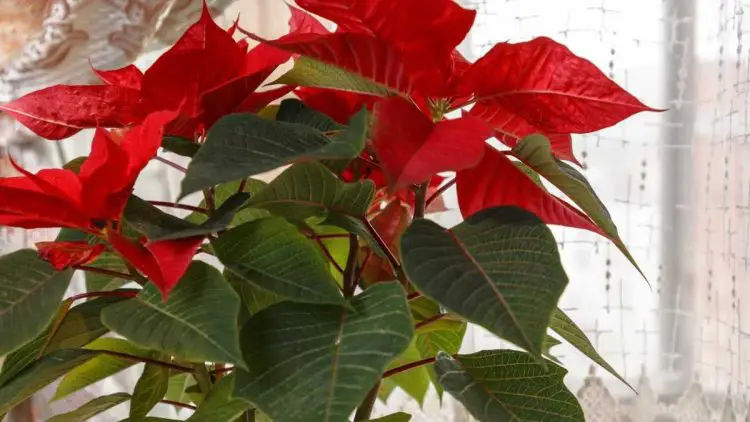
For over a century, the poinsettia has adorned German households as a beloved Advent houseplant. Despite its popularity, many end up discarding it after the holiday season, unaware that the “Euphorbia pulcherrima” is a perennial that can flourish again the next year.
By giving proper attention to your poinsettia, there’s no need to bid it farewell post-holidays. To ensure vibrant red leaves this year, a crucial detail needs attention in November. Discover the key to relishing a radiant poinsettia during the upcoming Advent season – the secret lies in lighting conditions.
Poinsettia’s Christmas Trick: The Role of Lighting
The poinsettia, a short-day plant, reveals its red flowers and leaves only when exposed to a maximum of eleven hours of light daily. Native to equatorial regions, this houseplant exclusively blossoms in winter in Central Europe, where fixed seasons dictate its growth. In tropical regions devoid of distinct seasons, the poinsettia flourishes independently, yet its flowering hinges on light conditions.
In its native habitat, where days never exceed twelve hours, the poinsettia experiences at least twelve hours of darkness daily. Consequently, in Central Europe, it enters its prime as the days shorten in late autumn, forming its signature red leaves just in time for Advent. Come February, as daylight hours extend, the poinsettia withers, only yielding green leaves.
It’s noteworthy that the red part of the plant isn’t technically a flower but a discolored bract. The actual flowers are small and yellow, nestled within the bracts.
Creating Native Conditions:
To mimic its native environment, start a “dark phase” for your poinsettia early in November. For the leaves to turn red, the plant should receive no more than eleven hours of light daily. Poinsettias available in garden centers have likely undergone this process. The “dark phase” must persist for at least six weeks, during which the plant should be placed in a dark location or covered for a few hours. Initiate this process now to witness its red leaves in time for Christmas.
Ideal locations for this phase include:
- Cellars without windows
- Clearance areas
- Unlit warehouses
If a suitable location is unavailable, cover the plant with an opaque bag or cardboard. Ensure regular watering during this phase.
After the “dark phase,” relocate your revived poinsettia to a preferred spot. Ideally, it should be warmer than 22°C, well-lit, sunny, and protected from drafts. Following these guidelines, the appearance of red leaves won’t be long. Your poinsettia will gleam brightly as Advent approaches!


